Unknown's avatar

About reveds

Occupation: Pastor, Ebenezer Presbyterian Church, Lennox, SD Education: BS - Christian Education, Sterling College; MDiv. - Princeton Theological Seminary Family: Married, with Four children. Hobbies: Running (will someday run a marathon), Sci-Fi (especially Doctor Who and Sherlock), Theater, and anything else my kids will let me do.

Encouragement from Old Letters

This afternoon I had the opportunity to pick up and dust off my copy of “Memoir and Remains of R.M. M’Cheyne.”  M’Cheyne was a Scottish Presbyterian minister, who lived from 1813 to 1843.  He was educated at the University of Edinburgh and at the Divinity Hall of his native city, where he was taught by Thomas Chalmers. He first served as an assistant to John Bonar in the parish of Larbert and Dunipace, near Falkirk, from 1835 to 1838. After this he served as minister of St. Peter’s Church (in Dundee) until his early death at the age of 29 during an epidemic of typhus.  Were it not for his friendship with Horatius Bonar (who is also know for many of his hymns) M’Cheyne’s writings would have been lost.  Fortunately, for us today, the wonderful letters, sermons, and poems of this young pastor have been preserved for us today.  I love this book, it’s one of my favorite biographies, and I find great encouragement and guidance as a Pastor from these memoirs from long ago.

Today, I thought I’d share the following letter from M’Cheyne to one of his church members who had initially written, complaining of the “plagues of the heart.”  I think it shows great pastoral care and compassion, but also demonstrates a lost art of Pastoral Letter writing.  Still, I think his encouragement to “cleave close to Christ” is one that we need to hear again and again.  May your hearts be strengthened as you read.

Passing on to glory

ST PETER’S, March 8, 1843.

MY DEAR FRIEND,—I send a few lines to you in answer to yours. You complain of the plague of your own heart, and so you will till you die. You know little yet of its chambers of imagery. All that is ours is sin. Our wicked heart taints all we say and do; hence the need of continual atonement in the blood of Jesus. It is not one pardoning that will serve the need of our souls. We must have daily, hourly pardons. I believe you are in the furnace, but it is a short one. Soon the Bridegroom will come, and we shall be with Him, and like Him, and God shall wipe away all tears from our eyes. I burst through all the cobwebs of present things, and, his Spirit anointing my eyes, look at Jesus as one beside me. Blessed Elder Brother, with two natures—God and man—ever-living, never-dying, never-changing! I was preaching last Sabbath on Heb. 9:13, 14: “He through the Eternal Spirit offered himself. It was very sweet to myself. In the afternoon I preached on Rev. 2:4, 5: “I have this against thee, that thou hast left thy first love.” I fear many of my people have done so; therefore it was very suitable. Several I see have felt it very deeply. In the evening I preached on Ps. 78:41: “They turned back, and tempted God, and limited the Holy One of Israel,”—on the sinfulness of limiting God. It was a very sweet and solemn day. Meantime, stay your soul on God. “Thou wilt keep him in perfect peace whose mind is stayed on Thee, because he trusteth in Thee.” A few more trials, a few more tears, a few more days of darkness, and we shall be for ever with the Lord! “In this tabernacle we groan, being burdened.” All dark things shall yet be cleared up, all sufferings healed, all blanks supplied, and we shall find fulness of joy (not one drop wanting) in the smile and presence of our God. It is one of the laws of Christ’s kingdom, “We must through much tribulation enter into the kingdom of God.” We must not reckon upon a smooth road to glory, but it will be a short one. How glad I am that you have “received the word in much affliction, with joy of the Holy Ghost!” Cleave closely to Jesus, that you may not have to say in a little, “Oh that I had affliction back again to quicken me in prayer, and make me lie at his feet!”

Trials make the promise sweet,
Trials give new life to prayer;
Trials bring me to his feet,
Lay me low, and keep me there.

This land will soon be strangely convulsed, if God prevent not. The plans now preparing for carrying the gospel into every corner of the land are sweet indeed. If I be spared and strengthened, I go to London towards the end of April. My stay must be very short. It is also intended to send me to the General Assembly in May. My poor flock, how I yearn over them! So many of them careless, and judgment at the door! Mr Burns comes to me to-morrow.
I must add no more, as I have work before me. May you experience more and more, that “when He giveth quietness, none can make trouble!”—even as you once experienced the other, “When He hideth his face, who then can behold Him?” Soon we shall see Him as He is; then our trials shall be done. We shall reign with Him, and be entirely like Him. The angels will know us by our very faces to be brothers and sisters of Jesus.
Remember Jesus for us is all our righteousness before a holy God, and Jesus in us is all our strength in an ungodly world. Persevere ever to death; eternal life will make up for all. I was reading to-day, “God hath granted repentance unto life.” Remember Barnabas’s advice, “Cleave to the Lord,”—not to man, but to the Lord. May He perfect all that concerneth you. Do not fear the face of man. Remember how small their anger will appear in eternity. Till then, believe me, your friend in gospel bauds, etc.

McCheyne, Robert Murray, and Andrew A. Bonar. Memoir and Remains of the Rev. Robert Murray McCheyne. Edinburgh; London: Oliphant Anderson & Ferrier, 1894. Print.
The Dangers of Professional Christianity

Does anyone know that the liturgical calendar calls the Sunday after Christmas?

Answer – Assistant Pastor’s Sunday.

Okay, it’s not an actual liturgical day – but boy am I glad the Assistant Pastor could fill in for me.

The last time I had taken a full day off from work was when I was on bedrest following a week in the hospital – and even then I started back to work before the Doctor’s recommended timeline.  I was feeling burned out. I just had to make it through Christmas Eve – and Christmas day since it fell on a Sunday – then I could finally get away for a little bit.

I read somewhere that there are a couple of clues to when a Pastor needs to take a break:

  1. When he repeats the same sermon two weeks in a row and the congregation doesn’t notice, and
  2. When he repeats the same sermon two weeks in a row and he doesn’t notice.

I hadn’t gotten to that point, but I was close.  Spending time away from the church – which is difficult for me since I live directly across the street from it – helped me to see how close I had come to a burnout.  From the realistic understanding that the work of the Church is essential, important, and urgent, to the unrealistic expectation that I can do it all myself and in my own strength; I stood little chance of survival.  I was increasingly frustrated with myself, making careless mistakes, growing short-tempered, and becoming an overall “bah-humbug.”  (My apologies to my family for bringing this on during Christmas, too – we always hurt the one’s we love…) Getting away for a week and realizing that the church would go on, even thrive, without me gave me that little jolt I need to get back into the proper perspective.

The time away also helped me to see that while my walk with Christ is essential to  my pastoral ministry, my pastoral ministry may often be a detriment to my walk with Christ.   There are several traps that are easy to fall into as a Pastor, shortcuts that seem to help make discipleship and pastoral ministry go hand in hand, but in reality, destroy both.

Here are just a few examples:

(Warning – there’s some brutally honest self disclosure coming here!)

Substituting Spiritual Studies for Spiritual Life

My workweek usually requires writing two sermons, planning and leading two worship services, writing a Sunday School and a Wednesday night bible study, writing this blog, and the occasional bible studies, devotions, and weddings and funerals – not to mention visitations, meetings, and the administration responsibilities of pastoral care.  Oh, and did I mention I have a wife and 4 kids, too.

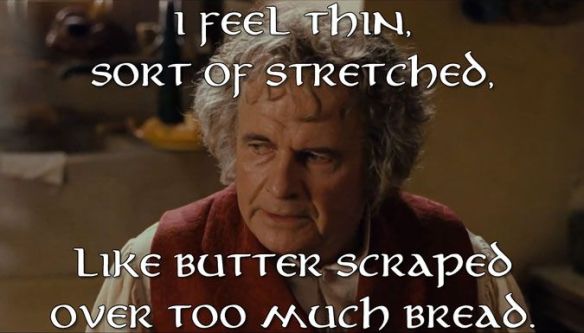
It is a joy to be called by a congregation to study, teach, and preach God’s Word, yet there are often times when the tyranny of the urgent, the never ending, relentless onslaught of Sundays overwhelms and incapacitates.  And then sacrifices are made.  The quiet time of study and reflection, listening to God’s Word for me personally is crowded out by the need to find something that I’m supposed to say to my congregation.  The time on my knees in prayer and fellowship with God finds its way to a prayer at the pastor’s desk.  Worship becomes work. Sanctification becomes sanctimony.  What should nourish and feed the Spirit becomes a drain, until you’re left, well, like this:

bilbo

Time away from the pulpit, from the office, from the demands of ministry, help me to find the peace and joy of stopping and dwelling in the presence of God.  Like that break in college when you went home, just for a bit, to be nurtured, strengthened, and rejuvenated for the return to reality – we all need moments when we can return to home base with God, resting and waiting upon Him.  Proverbs 18:10 says, “The name of the LORD is a strong tower; the righteous man runs into it and is safe.” I’m not one to run from my problems, but there are times when all you can do is drop everything and run to the Lord.  Only then can you find the strength and the wisdom to face what’s before you.

Worship as Perpetual Motion

I was sitting in worship in another Presbyterian Church on Sunday, with relative anonymity and no responsibility other than that I was there to worship God.  In that moment it dawned on me that I had gotten to the point where my preparation for worship, and my experience in worship on a Sunday morning had become an act of perpetual motion rather than heartfelt worship.  Like the “white-washed tombs,” I had fallen into a Pharisaical practice of having the name of God on my lips while He was far from my heart.

Okay, so maybe that’s a bit harsh, but maybe you know what I’m talking about.  Sundays came and went as a matter of course; I was going through the motions of worship, occasionally allowing my heart to actually break into what I was doing, but more often than not, that just took too much out of me – so I had to keep it all bottled up for the sake of moving forward.  When all the while, it was holding me back.

John Bunyan once wrote, “In prayer it is better to have a heart without words than words without a heart.”  Amen. Worship isn’t really worship if you’r heart is a million miles away.  If you’r heart isn’t fixed on God in worship, it isn’t a praise song, no matter how many times you repeat the chorus.

It took getting away from leading worship for a Sunday to get myself back into the right perspective for worship.  I’m only too grateful that God saw fit to show me this and restoration a heart of praise.

Trusting What’s Works Rather Than The One Who Works

Finally, it is all too easy to rely on the tools of the trade, rather than the Hands of the Master.  I have a pretty framed degree from a rather prestigious seminary on my wall – that should account for something, right?  I know my Greek and Hebrew, and can exegete a text forwards and backwards.  I bring a natural comfort to the pulpit, an easy manner in speaking, and that helps me communicate with the congregation.  With all of that going for me, this whole ministry thing should come together pretty well, shouldn’t it.

The temptation in ministry is to rely on my skills, my professional development, my education, my talents, my resources… You see what’s happening there.  If that’s the source of ministry, then all you’ll get is me.  Trust me, no one needs more of me.

Instead, all of this pedigree for ministry is simply rubbish compared to the surpassing greatness of knowing Christ Jesus.  How does Paul put in in Philippians:

But whatever gain I had, I counted as loss for the sake of Christ. Indeed, I count everything as loss because of the surpassing worth of knowing Christ Jesus my Lord. For his sake I have suffered the loss of all things and count them as rubbish, in order that I may gain Christ and be found in him, not having a righteousness of my own that comes from the law, but that which comes through faith in Christ, the righteousness from God that depends on faith— that I may know him and the power of his resurrection, and may share his sufferings, becoming like him in his death, that by any means possible I may attain the resurrection from the dead. (Philippians 3:7–11)

Interestingly, that was my foundation verse when I was in Seminary. Whatever I was confronted with, I would come back to this passage – I want to know Christ above all things, before all things, in all things.  It’s funny, that need never really goes away.

So – a huge thank you to my congregation and elders and assistant Pastor for making time away possible.  A huge thank you to my family and friends for bearing with me as I worked through all of this.  And a huge thank you to my savior, for being eternally patient with this work in progress.

SDG