Unknown's avatar

About reveds

Occupation: Pastor, Ebenezer Presbyterian Church, Lennox, SD Education: BS - Christian Education, Sterling College; MDiv. - Princeton Theological Seminary Family: Married, with Four children. Hobbies: Running (will someday run a marathon), Sci-Fi (especially Doctor Who and Sherlock), Theater, and anything else my kids will let me do.

Law and Grace in Les Miserables

“For the law of the Spirit of life has set you free in Christ Jesus
from the law of sin and death.”
(Romans 8:2)

One of the things I have always loved about Les Miserables is the rich characters who make up the story.  It is a three hour musical – but those three hours dig deeply into some incredible lives; lives of tragedy, villainy, despair, redemption.  We see this most clearly in the stark contrast between Valjean and Javert, two characters whose stories share the same root (Valjean spent 19 years in prison, Javert was born in a prison), but whose lives eventually take dramatically different paths.

We first meet Javert as he is releasing Jean Valjean from the galleys.  Immediately we see the nature of his character.  He is quick to remind Valjean that while he may be free from prison, he will always be a criminal and a scourge to society.  We find in Javert an embodiment of unrelenting, unmoving, merciless law.

When we next encounter Javert, he is an inspector who has achieved his status by virtue of his diligence and perfect adherence to the law.  Meanwhile, Valjean has become the owner of a factory who business has saved the town and is appointed as Mayor.  Valjean success, however, comes not through his own merits, but by the mercy of a Bishop who shows him grace and changes Valjean forever.

As a man of the law, Javert is cannot show compassion: mercy corrupts divine order, the law is as fixed as the stars, it will not be mocked, he will not be moved.  Justice trumps all.  Valjean, on the other hand because of the extravagant grace shown to him, recognizes the Divine hand of grace that saves the wretch and sets him free.  Touched by grace, Valjean gives that grace to others, caring for Fantine and her daughter Cosette, and even sparing Javert’s life multiple times.

Ultimately, we see in Valjean and Javert two lives that are forever changed by grace.  One receives grace and mercy and is re-born to live a life of compassion and love for those around him.  The other rejects that grace, sees it as an affront to his own self-righteousness, and in rejecting grace, is doomed to destruction.

Sadly, there are many today who love Valjean, but live like Javert.  Grace and mercy, as concepts are fine, but in practice tend to make a mess of things.  We want what’s coming to us, we demand our fair share.  Mercy has a way of upsetting the apple cart, of negating our best-efforts.  We put a pretty shine on “respectable peccadillos ” and avoid the more heinous sins, so shouldn’t God recognize our good efforts and reward us based on that?  I have actually had someone tell me, “Why does that Amazing Grace song call us wretches – we’re not that bad.”

It is as if Javert has read Romans 1-7, and when confronted with Valjean’s grace, cries out with Paul, “I see in my members another law waging war against the law of my mind and making me captive to the law of sin that dwells in my members.  Wretched man that I am!  Who will deliver me from this body of death?”  Unfortunately for Javert, he stops reading there, and ends his life in despair.

Valjean, however, turned the page and continued to Romans 8:1-2, “There is now no condemnation for those who are in Christ Jesus.  For the law of the Spirit of life has set you free in Christ Jesus from the law of sin and death.”

Friends we were all “from the gutter,” we are all under sin.  “None is righteous, no, not one; no one understands, no one seeks God.  All have turned aside; together they have become worthless, no one does good, not even one” (Rom 3:10-12).  Will you take the course of Javert, only to learn that “by works of the law no human being will be justified in [God’s] sight, since through the law comes the knowledge of sin (Rom 3:20).  Or will you stand in the need of grace with Valjean and find that “there is no distinction: for all have sinned and fall short of the glory of God, and are justified by his grace as a gift, through the redemption that is in Christ Jesus” (Rom 3:22-24).

Don’t miss your chance to see this show.  If you’re in NW Iowa, get your tickets now.

More importantly, don’t miss out on the gift of grace that God has given in Christ.

SDG
Living By Grace: A Study of Jean Valjean

“Therefore, my beloved… work out your own salvation with fear and trembling,
for it is God who works in you, both to will and to work for his good pleasure.”
(Philippians 2:12–13)

With every role I’ve had in community theater, I have tried to write up a brief character study.  I find this helps me develop my character and to understand his actions and his significance in the larger story.  As I step into an iconic role like Jean Valjean in the Cherokee Community Theater production of Les Miserables, a part that has been played by some phenomenal actors, a character whose story is known and loved by so many, I thought I would share some of my thoughts on this character and the powerful message that he presents.

Les Miserables, as a novel, is Victor Hugo’s reproachful commentary on society and its treatment of the poor, the uneducated, and the suffering of women in his time.  Within this critique unfolds a story of the redeeming and transforming power of love and grace, set in stark contrast with the inability of the law and revolution to affect any real change on the human condition.  The musical focuses primarily on the story of the redemption of Valjean, and his effort to live worthy of the grace he has been given.

Here’s what we know of Valjean:

(All of the quotes are taken from Victory Hugo’s Les Miserables, http://www.classicreader.com/book/268/).

Jean Valjean was orphaned at an early age and raised by his older sister.  When Valjean was 25, his sister’s husband died, leaving her with seven children under the age of 8, and him taking the father’s place in the family, “simply as a duty and even a little churlishly” on his part.  A hard winter came, and without work, they had no food.

In desperation, Valjean robbed a baker’s house, breaking a window and stealing a loaf of bread to feed his family.  He was captured, and sentenced to 5 years of hard labor, serving as a slave in the galleys.  He never again saw his sister or her children for, as Hugo says, “what becomes of the handful of leaves from the young tree which is sawed off at the root?”

While in the galleys, Valjean tried to escape three times, only to be recaptured and sentenced to more prison time.  In total, he spends 19 years in prison for stealing a loaf of bread.  He entered “the galleys sobbing and shuddering; he emerged impassive. He had entered in despair; he emerged gloomy.”

When finally released, Valjean blamed himself for his wasted life.  He knows he would have been given the bread had he asked for it; that his act of violence benefited no one.  At the same time, Valjean also blamed society for punishing a man unjustly, and he blamed God, for having created such a society.  He condemned himself, society, and God; he had nowhere to turn.

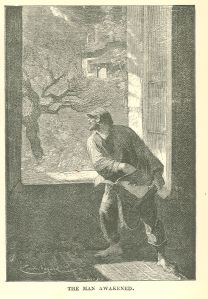
Valjean ivaljean awakeneds paroled, but everywhere he goes he is treated less than human.  He cannot work, he cannot

find lodging; he is a dog on the streets.  There is no compassion, no mercy, just law and condemnation at every step.  Until, that is, he meets Bishop Myriel.  The Bishop takes Valjean into his home, feeds him, offers him a place to rest, and when Valjean is arrested for stealing the silver from the church, the Bishop offers him the candlesticks he had left – giving him forgiveness, giving him a second chance, giving him grace.

When faced with such grace Valjean had two options: “if he were not henceforth the best of men, he would be the worst; that it behooved him now, so to speak, to mount higher than the Bishop, or fall lower than the convict; that if he wished to become good be must become an angel; that if he wished to remain evil, he must become a monster… That which was certain, that which he did not doubt, was that he was no longer the same man, that everything about him was changed, that it was no longer in his power to make it as though the Bishop had not spoken to him and had not touched him.”

The rest of the story comes down to how Valjean responds to this grace.  I won’t go into all the details (read the book, or come see our show), but from his encounter with grace, Valjean is a changed man, and with every day he seeks to live a life worthy of such a gift.  Alive because of grace, grace flows freely to others, bringing help and hope to those in greatest need.

What I love about the character of Valjean is that he is truly an “everyman.”  He stands as a symbol for  the human condition, our need for transforming grace and love, and our struggle to live according to that love once we find it.

In a way we are all like Valjean, cut off from the blessings of God because of our sin.  We fall under the penalty of the law and are crushed under the weight of sins consequences.  Each sin compounds our guilt and our burden.  We think ourselves free, but our freedom is an illusion, for in sin we are bound to sin and to the law.

Then we encounter grace.  As Paul writes in Eph. 2:4-7, “But God, being rich in mercy, because of the great love with which he loved us, even when we were dead in our trespasses, made us alive together with Christ – by grace you have been saved – and raised us up with him and seated us with him in the heavenly places in Christ Jesus.”  This grace liberates us from the law.  This grace transforms the wretched soul.  This grace brings peace and joy to the burdened heart.  This grace gives life to the dead.

And this grace calls us to walk in a new and different way.  Valjean knew he could not act as if the Bishop had not touched his life.  When God touches your life, you cannot be the same.  This is why Paul writes to the Philippians, “Therefore my beloved… work out your salvation with fear and trembling, for it is God who works in you, both to will and to work for His good pleasure” (Phil. 2:12-13).

When you have known the grace of God in Jesus, the rest of your life is lived trusting in that grace, living according to that grace, and sharing that grace with others.  Grace runs through every part of life.  Grace is that which saves.  Grace is that which restores.  Grace is that which gives us strength to go forward.  If we live at all, we live by grace alone.

I hope that my performance in the role of Jean Valjean in some way communicates this transformation in grace, and that through this show God may be glorified and known and the God of grace and love.

SDG

les mis add