
Unknown's avatar

About reveds

Occupation: Pastor, Ebenezer Presbyterian Church, Lennox, SD Education: BS - Christian Education, Sterling College; MDiv. - Princeton Theological Seminary Family: Married, with Four children. Hobbies: Running (will someday run a marathon), Sci-Fi (especially Doctor Who and Sherlock), Theater, and anything else my kids will let me do.

Bound to Love and Truth

Reading through Proverbs 3 today I was struck by a passage that I (sorry to say) usually overlook. When I hear someone refer to Proverbs 3, my mind is usually drawn to verses 5 & 6:

“Trust in the Lord with all your heart, lean not on your own understanding, in all your ways acknowledge Him, and He will make straight your paths.”

I’ve taught this passage so many times. There are songs to help you memorize it. The verse is underlined, highlighted, emboldened, so much so that it dwarfs the rest of the chapter.

And it shouldn’t.

I was particularly struck in today’s reading by the immediately preceding verses 3 & 4:

“Let not steadfast love and faithfulness forsake you; bind them around your neck, write them on the tablet of your heart. So you will find favor and good success in the sight of God and man.”

The word for “steadfast love” in this text is none other than הסד, pronounced “chesed,” which refers to the faithful covenant love of God for His people. Likewise, “faithfulness” is from the Hebrew, אמת, pronounced “emet,” which can also be translated as “truth,” and is expressive of God’s covenant keeping.

Just sitting and reading this passage, “do not let steadfast love and faithfulness forsake you” makes us think that this is something we need to do. Without digging deeper into this passage, we might glance at it and think, Well, I better try to be more loving and faithful in order to find favor and good success in the eyes of God and man.

But that’s not the case.

The author of Proverbs here is calling us to mindfulness. He’s not talking about our steadfast love and faithfulness, but God’s. It is God who is steadfast in His covenanted love for His people, and faithful and sure to keep all His promises. The point of this passage is not to try harder, but to remember the covenant keeping nature of our great God.

God has promised to save, and has saved mightily in Jesus Christ. When we were dead in our sins and trespasses, God, in His love and mercy, did send His Son who would take our guilt, our shame, bearing our sins upon His cross, so that we might, by His grace receive forgiveness and the promise of everlasting life. We receive all this, not through our own effort, but through faith in Jesus Christ, resting in and receiving Him as He is revealed in God’s Word. This is the blessing of God’s covenanted love and faithfulness.

So when we are called to bind steadfast love and faithfulness around our necks and to write it upon our hearts, it’s not our own, but God’s love and faithfulness.

The promise given here, that we would find favor and success, are also magnified in the Hebrew. “Favor” here is the Hebrew word הן, pronounced “hen,” which is usually translated as “grace,” or “gift.” And “success” here is from שכל, sekel, which is elsewhere translated as “discernment, understanding.”

We are to set this truth of who God is and what He has done so close to us, that they reshape us, they reform us, they help us to see everything through the lens of God’s love and truth.

What a promise for God’s people! If we would keep before us the love and faithfulness of God, bind them around our necks, write them on our hearts, so that we would continually be reminded of all that God has done, and is doing for us in Christ Jesus, how we would grow in the grace and knowledge of God.

SDG
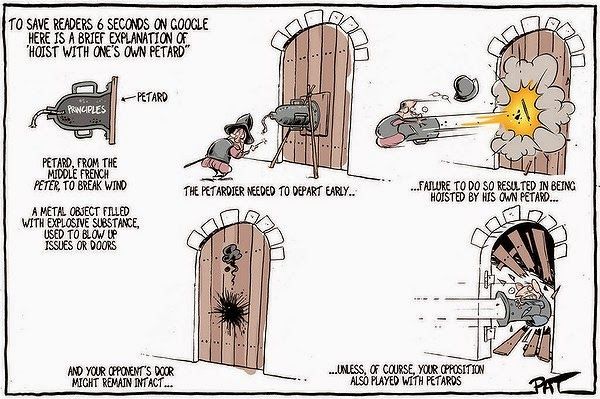
Hoisted on their own Petard

In the book of Esther, Haman, right-hand man to King Ahasuerus, despised Mordecai and all the Jews, and sought to destroy them. With the permission of the King, Haman funded and organized a day when all the Jews in the Persian Empire would be put to death (Esther 3:7-11).  Were that not enough, Haman also built a gallows 75 feet tall upon which to hang Mordecai personally.

If you know the story,Queen Esther, also a Jew, intervenes, risks an audience with King, revealing Haman’s plot. She helps her people by allowing them to defend themselves, since the King’s edict could not be revoked; a day that is still celebrated as Purim. To top it off, Haman threw himself at Esther begging for mercy, and when King Ahasuerus saw it, he had Haman hanged on the very gallows he had prepared for Mordecai.

Talk about ironic justice.

This is what it means to be “hoisted by your own petard,” to be undone by your own creation. That phrase, coined by Shakespeare in Hamlet, Act 3, Scene 4.  Here, the characters Rosencrantz and Guildenstern are given letters ordering Hamlet’s execution, but he changed the letters, and they carried their own death summons unknowingly. Hamlet then says, 

“For ’tis the sport to have the engineer hoist with his own petard; 
and ’t shall go hard but I will delve one yard below their mines
And blow them at the moon.” 

To be “hoist by your own petard” quite literally means to be “lifted up by your own bomb.” A petard was a small explosive device that was used to blow doors off their hinges in military raids. (Interestingly, the word petard originally was French, meaning “break wind,” or as we’d say, “a fart” – so there’s that image.)

In His Sermon on the Mount, Jesus taught “when you give to the needy, sound no trumpet before you, as the hypocrites do in the synagogues and in the streets, that they may be praised by others. Truly, I say to you, they have received their reward” (Matt 6:2). The reward, the goal of the hypocrites and the self-righteous is to be seen and praised by man, and they do all that they do for the glory of man. That’s why Jesus said they have received their reward. When the praise and glory of man is your goal, it will also be your undoing.

How do hypocrites receive their rewards today? We are quick to cut others down to make ourselves look good. We put on a fine show for other to see, masking the inward insecurities and sinful desires. We compare ourselves with others, and assure ourselves that our self-righteousness is sufficient.

But what happens when the standards change? Those things that gain the attention and admiration of the world around you are always changing. The behavior that once brought your the laud and approval of others is one social shift away from bringing you cancelation and derision.  Politicians who were heralded by the press are now pariahs, excoriated though they only do what they’ve always done. If you will say, do, and be whatever the culture demands just to gain fame, be warned, that will be the very thing that brings you infamy.

Later in the gospel of Matthew, Jesus told his disciples, “If anyone would come after me, let him deny himself and take up his cross and follow me.  For whoever would save his life will lose it, but whoever loses his life for my sake will find it” (Matt 16:24–25). Haman built the gallows to bring his enemies down, and it led to his own demise. Rosencrantz and Guildenstern were killed by the very letters they carried.  Living your best life now will only bring you the worst through eternity.  Jesus calls his disciples to lay down their own lives, taking up the cross, and following Him. It is only when we lose our lives, laying down our selfish, self-centered, and self-seeking, seeking first the Kingdom of God and His righteousness that we actually find life in Christ.