
Hoisted on their own Petard

In the book of Esther, Haman, right-hand man to King Ahasuerus, despised Mordecai and all the Jews, and sought to destroy them. With the permission of the King, Haman funded and organized a day when all the Jews in the Persian Empire would be put to death (Esther 3:7-11).  Were that not enough, Haman also built a gallows 75 feet tall upon which to hang Mordecai personally.

If you know the story,Queen Esther, also a Jew, intervenes, risks an audience with King, revealing Haman’s plot. She helps her people by allowing them to defend themselves, since the King’s edict could not be revoked; a day that is still celebrated as Purim. To top it off, Haman threw himself at Esther begging for mercy, and when King Ahasuerus saw it, he had Haman hanged on the very gallows he had prepared for Mordecai.

Talk about ironic justice.

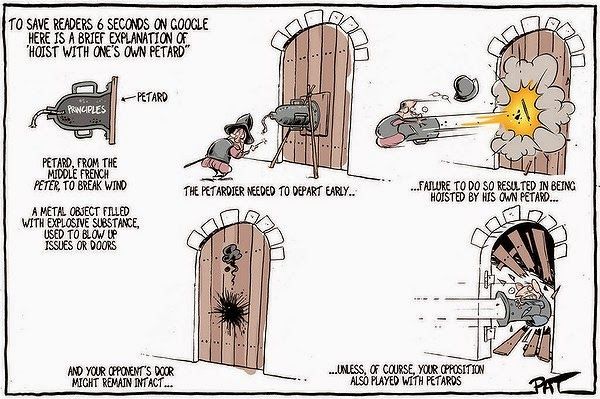
This is what it means to be “hoisted by your own petard,” to be undone by your own creation. That phrase, coined by Shakespeare in Hamlet, Act 3, Scene 4.  Here, the characters Rosencrantz and Guildenstern are given letters ordering Hamlet’s execution, but he changed the letters, and they carried their own death summons unknowingly. Hamlet then says, 

“For ’tis the sport to have the engineer hoist with his own petard; 
and ’t shall go hard but I will delve one yard below their mines
And blow them at the moon.” 

To be “hoist by your own petard” quite literally means to be “lifted up by your own bomb.” A petard was a small explosive device that was used to blow doors off their hinges in military raids. (Interestingly, the word petard originally was French, meaning “break wind,” or as we’d say, “a fart” – so there’s that image.)
In His Sermon on the Mount, Jesus taught “when you give to the needy, sound no trumpet before you, as the hypocrites do in the synagogues and in the streets, that they may be praised by others. Truly, I say to you, they have received their reward” (Matt 6:2). The reward, the goal of the hypocrites and the self-righteous is to be seen and praised by man, and they do all that they do for the glory of man. That’s why Jesus said they have received their reward. When the praise and glory of man is your goal, it will also be your undoing.

How do hypocrites receive their rewards today? We are quick to cut others down to make ourselves look good. We put on a fine show for other to see, masking the inward insecurities and sinful desires. We compare ourselves with others, and assure ourselves that our self-righteousness is sufficient.

But what happens when the standards change? Those things that gain the attention and admiration of the world around you are always changing. The behavior that once brought your the laud and approval of others is one social shift away from bringing you cancelation and derision.  Politicians who were heralded by the press are now pariahs, excoriated though they only do what they’ve always done. If you will say, do, and be whatever the culture demands just to gain fame, be warned, that will be the very thing that brings you infamy.

Later in the gospel of Matthew, Jesus told his disciples, “If anyone would come after me, let him deny himself and take up his cross and follow me.  For whoever would save his life will lose it, but whoever loses his life for my sake will find it” (Matt 16:24–25). Haman built the gallows to bring his enemies down, and it led to his own demise. Rosencrantz and Guildenstern were killed by the very letters they carried.  Living your best life now will only bring you the worst through eternity.  Jesus calls his disciples to lay down their own lives, taking up the cross, and following Him. It is only when we lose our lives, laying down our selfish, self-centered, and self-seeking, seeking first the Kingdom of God and His righteousness that we actually find life in Christ.

(more) Thoughts on Worship

Several years ago I was asked to lead a lay-pastor training course on Worship in the Reformed Tradition. In the preparation for the class, I took copious amounts of notes from books that I was reading and recommending to the class. I find that I still turn to those quotes quite often, so I thought I’d share some of them here. Enjoy.

From: Hughes Oliphant Old, “Guides to the Reformed Tradition” (Worship.  Atlanta: John Knox Press, 1984):

“We worship God because God created us to worship him.  Worship is at the center of our existence; at the heart for our reason for being.  God created us to be his image – an image that would reflect his glory.”

“When those who worship the holy God become through that worship holy themselves, they show forth the praises of him who has called us out of the darkness into his marvelous light… Holiness is the fruit of worship.  By purifying the worshipers the worship is made pure.  When we worship, having our minds enlightened by the Spirit, our lives cleansed by the Spirit, our wills moved by the Spirit, and our hearts warmed by the Spirit, then our worship is transformed from being a mere human work into being a divine work.”

From John MacArthur, “Pastoral Ministry: How to Shepherd Biblically.” (Nashville: Thomas Nelson, 2005):

“Worship is ascribing to God His worth, or stating and affirming His supreme value.So to talk about worship is to talk about something we give to God.  Modern Christianity seems committed, instead, to the idea that God should be giving to us.  God does give to us abudnatly, but we need to understand the balance of that truth.  We are to render ceaseless honor and adoration to God.  That consuming, selfless desire to give to God is the essence and the heart of worship.  It begins with giving first of ourselves, and then of our attitudes, and then of our possessions, until worship is a way of life.”

From D.A. Carson, “Worship by the Book,” (Grand Rapids: Zondervan, 2005):

“We  cannot imagine that the church gathers for worship on Sunday morning if by this we mean that we then engage in something that we have not been engaging in the rest of the week.”

“Worship is the proper response of the creature to the Creator.”

“You cannot find excellent corporate worship until you stop trying to find excellent corporate worship and pursue God himself.”

“If you wish to deepen the worship of the people of God, above all deepen their grasp of his ineffable majesty in his person and in all his works.”

“Worship, properly understood, shapes who we are.  We become like whatever is our god.”

“To say that we come together “to worship” implies that we are not worshiping God the rest of the time.  And that is so out of touch with the New Testament emphases that we ought to abandon such a notion absolutely…  The people of God should worship him in their individual lives and in their family lives and then, when they come together, worship him corporately.”

From David Wells, “God in the Whirlwind: How the Holy-love of God Reorients Our World,”(Crossway. Kindle Edition):

“We come to the Lord, not because it is our idea to do so, or because we need to do so, or even because we like to do so, but because he first came to us. Worship is our response to what he has done. Worship undoubtedly can have its benefits. However, it is not primarily about our finding comfort, inspiration, or social connections, or being entertained. It is primarily about adoration and praise being directed to God simply for who he is and what he has done. Worship loses its authenticity when it becomes more about the worshiper than about the God who is worshiped.”

“A congregation is a fellowship of sinners, those who know their own waywardness, their own willfulness, and how much they need to be redeemed. It is precisely those who know such things who are in churches or, at least, ought to be. For it is here, in the company of others, that we learn of God’s goodness and of his grace. It is here that we think together about life and its meaning. We are enriched through the gifts that God has given in the church.”