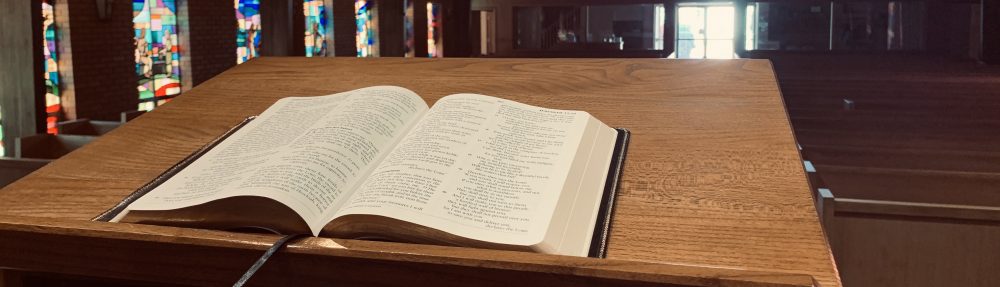
My daily reading plan has me in the middle of the book of Leviticus right now, which is always a challenge. I am constantly amazed at the amount of sacrifice, the blood required to atone for the sins of the people, the sacrifices given in praise, prayer, and petition to God. The ceremonial regulations are abundant and exhaustive. When our culture seems so casual in its approach to the Holy God, the book of Leviticus seems very foreign and difficult to accept.
Today’s reading was Leviticus chapter 13, the laws regarding leprosy and a variety of skin diseases. “When a person has on the skin of his body a swelling or an eruption or a spot, and it turns into a case of leprous disease on the skin of his body, then he shall be brought to Aaron the priest or to one of his sons the priests, and the priest shall examine the diseased area on the skin of his body. And if the hair in the diseased area has turned white and the disease appears to be deeper than the skin of his body, it is a case of leprous disease. When the priest has examined him, he shall pronounce him unclean” (Lev 13:2-4).
If you read through the rest of the chapter, you’ll find calls for quarantining those who were symptomatic, to determine if it was leprosy or some other condition. There are regulations about leprosy on the skin, beard, and in the clothes. If the priest determined it was leprosy, you were declared unclean, and thereby unable to come into the presence of the Temple for sacrifice and worship.
I can’t tell you how hard it was a a pimply teenager to read these passages and wonder if God would even hear my prayers in my current condition, or if I was too unclean to come before Him.
These regulations were in place for the sake of the community. In Biblical times, there was no cure for leprosy, but they knew it spread easily and quickly through a community. If you were showing symptoms, you were required to let others know, and keep distance from the rest of the community.
I think we all know a little about this now. With the state imposed quarantines and calls for social-distancing over the Coronavirus, we see the cases come to our community and cry, “Unclean! Unclean!” There is a palpable fear of the spread of this virus, of the infection spreading like wild-fire. The worst part of this, unlike leprosy, Covid 19 may spread from those who are asymptomatic. You could be carrying the virus and show now signs, but still pass it along to others.
So we stay home, out of love and concern for those around us. We are, to some extent, embodying the practices of Leviticus 13.
But only to a certain extent.
It is equally important to remember that these practices were not just regulations for the community, they were regulations for the worshipping community. Leviticus was written primarily as instruction about how a sinful people were to approach a Holy God. If one were to come into the presence of God, still stained and burdened by sin, God, who is holy and just, would pour down unmitigated judgment upon the sinner. This is why there is so much blood sacrifice in Leviticus – the people were making atonement for their sins so that they could stand justified before a holy God.
Psalm 15, another reading of the day, asks and answers the question, “O Lord, who shall dwell on your holy hill?” The answer given is this, “He who walks blamelessly and does what is right and speaks the truth in his heart; who does not slander with his tongue and does no evil to his neighbor, nor takes up a reproach against his friend; in whose eyes a vile person is despised, but who honors those who fear the Lord; who swears to his own hurt and does not change; who does not put out his money at interest and does not take a bribe against he innocent. He who does these things shall never be moved.” This is the one who may come before the Lord.
Leprosy, a disease of the skin, was symbolic of the disease of the heart – sin. Easily spread, entirely destructive. Left untreated, it will bring about our destruction, and leave us separated from God.
What a wonder then to know that in Jesus Christ we have been washed and made clean (Hebrews 9:14; 10:13). We, who were once stained with the sins of this world, are now declared clean, sanctified by faith in Jesus Christ (1 Cor 6:11). The punishment for your sins has been placed upon Christ, and has been paid for in full. The veil which separated us from God has been torn open, and we have access to the Father through Jesus Christ our mediator.
What a blessing it is to know that, while we must be separated from one another for this time, nothing can separate us from the love of God the Father through Jesus Chris the Son (Rom 8:38-39).
SDG
 Reveds's Blog