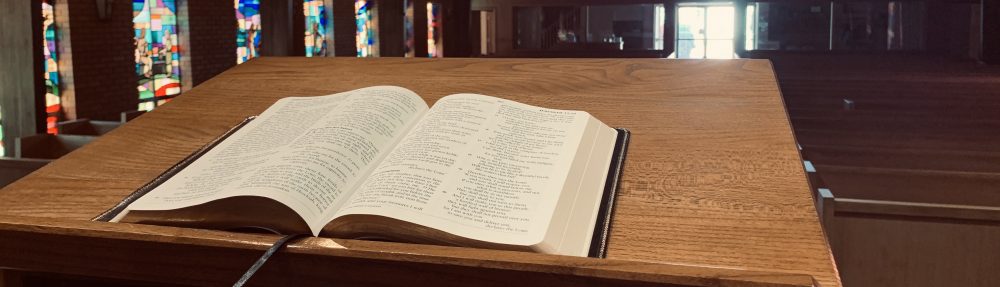
Hosea 1:1 – “The word of the LORD that came to Hosea…”
It’s a simple phrase, easy to glide over: “The word of the LORD came to Hosea.” But the more you sit with it, the more wonder it holds. How did the Word come? Was it a voice Hosea could hear with his ears? A vision blazing across his mind? A sudden, irresistible impulse of the Spirit that left him trembling?
Scripture doesn’t tell us. And perhaps that’s intentional. Because what mattered most was not the manner of revelation, but its source. Hosea didn’t dream up his message or craft it out of religious insight. He received it. The word came to him.
The prophets were not spiritual inventors but faithful messengers. Whether God spoke by a voice, a vision, or a burning conviction, the result was the same: “Men spoke from God as they were carried along by the Holy Spirit” (2 Peter 1:21). Calvin put it this way:
“The prophets did not speak at random, but as organs of the Holy Spirit, they only uttered what they had been commissioned to declare.”
That’s what we call inspiration—the Spirit of God superintending the words of men so that what they wrote was, in every part, the Word of God. As Paul wrote to Timothy, “All Scripture is God-breathed” (2 Tim. 3:16). God didn’t simply whisper ideas and leave the prophets to fill in the rest. Nor did He bypass their minds and turn them into secretaries taking dictation. The miracle of inspiration is that the living God spoke His perfect Word through human voices—each shaped by its author’s time, place, and personality, yet free from error and filled with divine authority.
The Westminster Confession says it this way:
“The Old Testament in Hebrew, and the New Testament in Greek, being immediately inspired by God… are therefore authentical.” (WCF 1.8)
In other words, when we open the Bible, we are not reading about the Word of God; we are hearing the Word of God.
And yet, if we’re honest, we don’t always hear it that way. We can open our Bibles and walk away unchanged. The words may sound no different than those on the morning news or a grocery list.
This is why the Reformers spoke not only of inspiration, but also of illumination. The same Spirit who once inspired the prophets must now illumine the hearts of hearers. The Westminster Confession explains:
“Our full persuasion and assurance of the infallible truth and divine authority thereof, is from the inward work of the Holy Spirit bearing witness by and with the Word in our hearts.” (WCF 1.5)
Without that inward work, the Word remains a closed book. Jesus said as much when He told Nicodemus that unless one is born of the Spirit, he cannot even see the kingdom of God (John 3:3). The problem isn’t with the light of God’s Word, but with the blindness of our hearts.
When the Spirit opens our eyes, we begin to see that the Bible truly is what it has always been—the living and active Word of God. The change is not in the Word, but in us. The same Scriptures that once seemed distant or dull suddenly shine with divine truth. We no longer simply read them; they read us. They convict, comfort, direct, and delight. The same God who spoke to Hosea through revelation now speaks to His people through the written Word—and by His Spirit, that Word pierces to the division of soul and spirit (Heb. 4:12).
So when we read that “the word of the LORD came to Hosea,” we’re reminded that God still comes to His people by His Word. Not in fresh revelation—Scripture is complete and sufficient—but in fresh illumination. The Spirit still takes the inspired Word and presses it upon our hearts with divine power.
Every time you open your Bible, the living God is speaking. The question is not whether He will speak, but whether we will listen. And so we pray with Samuel, “Speak, LORD, for your servant hears.”
And if that sounds a bit too mystical, remember—it’s not that we wait for a new voice from heaven. We simply wait for the Spirit to make the written Word living in us. The word that came to Hosea still comes, by grace, to all who have ears to hear.
SDG
 Reveds's Blog