
Reliable Sources

It was also about these that Enoch, the seventh from Adam, prophesied, saying, “Behold, the Lord comes with ten thousands of his holy ones,  to execute judgment on all and to convict all the ungodly of all their deeds of ungodliness that they have committed in such an ungodly way, and of all the harsh things that ungodly sinners have spoken against him.”
Jude 14–15 (ESV)

In today’s high-volume, constant barrage of media and information, you have to be very careful which sources you listen to. I think this meme sums it up best: 
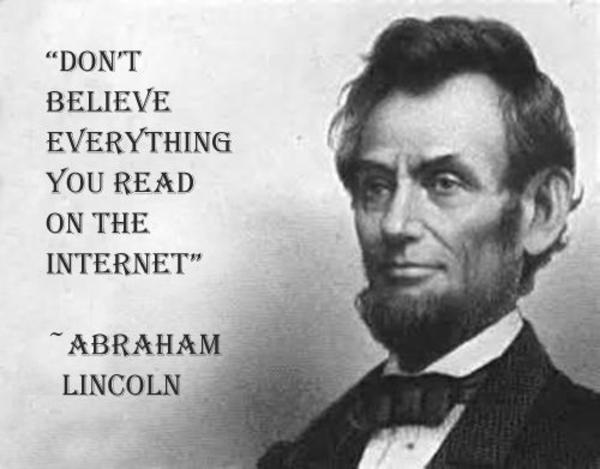
“Don’t believe everything you read on the internet.” Abraham Lincoln

As we read through the book of Jude, what we receive as the inspired and authoritative word of God, we come to verses 14 and 15 where Jude quotes from the Book of Enoch. Enoch, you’ll recall in Genesis 5:18-24, is the descendant of Adam who “walked with God, and he was not, for God took him.” Because of the uniqueness of Enoch’s life, legend developed that he was a prophet who testified to the coming judgment of God, and these prophesies were contained in the Book of Enoch.

Enoch was never considered to be part of the Hebrew canon, nor was it accepted as an inspired and authoritative text in the Christian Scriptures. Still, it is believed to have been a popular book, circulated mostly during the 3rd and 4th century BC, with some fragments included among the Dead Sea Scrolls. Much of the content of Enoch’s work is really a commentary (Midrash) on the word of God. In fact, the quote Jude draws from Enoch 1:8 is nothing more than an application of Deuteronomy 33:2.

Should we then try to be more familiar with the Book of Enoch? What does Jude’s quotation from this source tell us about the inspiration of the Word? As the ESV Study Bible notes states, “The use of extra biblical literature does not mean that any of these literary works are authoritative words of God in the same category as Scripture. Jude is simply drawing from 1 Enoch another example of judgment, which means that, in at least this specific instance, 1 Enoch contains truth.” Paul does this in Acts 17, quoting from pagan philosophers in order to emphasize his point. In both cases, they are using thoughts and teachings that the audience would have recognized in order to illustrate their message. It is no different than when a preacher will quote from a commentary or a popular contemporary source in order to bring clarity or to reinforce the message. 

So what is being said? This much is clear. The false teachers who have come into the Church, twisting the message of the gospel into sensuality and leading people away from their Lord and Master Jesus Christ will come under tremendous judgment. The Lord is coming to convict the ungodly of their ungodliness that they have committed in ungodly ways. Those who are without God cannot do what God desires.  The absence of God is evil in and of itself, and all ungodliness will be judged when the Lord comes again. This judgment is sure. 

Jude is nearing the end of his rebuke against these false teachers and he wants to make this point clear: while the ungodly may gain ground and prosper here and now, there is an unavoidable coming judgment. This promise of judgment comes as both threat and assurance; a threat to the ungodly that their deeds do not go unnoticed, an assurance to the godly, that the Lord will act in righteousness to bring an end to all evil.

SDG

3 Warnings and a Funeral

“Woe to them! For they walked in the way of Cain
and abandoned themselves for the sake of gain to Balaam’s error
and perished in Korah’s rebellion.”
Jude 11

There are certain stories in the Scriptures that you would like to have represent your life. My name being a Biblical name, I have always hoped to be characterized like the Ethans of the OT, one was a singer in David’s assembly as they brought the ark of the covenant into Jerusalem (1 Chron 15:19), another was one of the wise men in Solomon’s court (1 Kings 4:31), one Ethan composed Psalm 89. Go Ethan!

Of course who wouldn’t want to be counted as one of the of the faithful servants in the Parable of the Talents, hearing from our Lord, “Well done good and faithful servant…” (Matthew 25:21). Apart from the grace of God, however, we’d all end up like the other servant who hid the master’s talent, “You wicked and slothful servant…” (Matthew 25:26).

Isn’t interesting, then, so see which Biblical narratives Jude uses to describe the false teachers who have crept into the church, twisting the grace of God into sensuality and rejecting our Lord and Master, Jesus Christ. Already Jude has compared them to the unfaithful Hebrews who died in the wilderness, the angels who fell from glory, and the people of Sodom and Gomorrah in their immorality and unnatural desires.

In our reading from Jude today, the Biblical analogies continue. Each warning is taken from key stories from Israel’s history, each ending in death (thus the title).

  • They have walked in the way of Cain.  It was Cain who killed his brother Abel in jealousy over the fact that God honored Abels overing over his own. Keep in mind, it was Abel who brought the firstborn of is flock, while Cain brought an offering of the fruit of the ground. Many speculate that the difference in the offering was that Abel brought the firstborn while Cain brought something lesser, but that misses the point. The bigger issue here is the heart of the worshipper. As Romans 14:23 teaches, “whatever does not proceed from faith is sin.” As Abel’s offering was accepted, we must understand that he gave his offering in faith in the Lord. Cain offering was rejected, so we may surmise that he did not bring it in faith, but merely out of duty or religious custom. His heart, as we see in Gen 4, was filled with hatred for his brother, and he walked in darkness (1 John 2:11).
    This is the hypocrisy of the false teachers. They came to the Lord through religious customs, but they had not part or lot in the Lord.  Warren Wiersbe wrote, “The ‘way of Cain’ is the way of religion without faith, righteousness based on character and good works. The ‘way of Cain’ is the way of pride, a man establishing his own righteousness and rejecting the righteousness of God that comes through faith in Christ.” They said they worshiped the Lord, but they did not come in faith, but their teachings would lead to the destruction (murder) of many. In this way they were walking in the way of Cain.
  • They abandoned themselves for the sake of gain to Balaam’s error. Balaam’s story is a cautionary tale. He was hired by Balak to proclaim curses on Israel as they were in the wilderness. Now anyone claiming to be a prophet could do this, and get paid well for it. But something unexpected happened.  God actually spoke to Balaam. God warned him not to say anything that God didn’t tell him to say. So 4 times Balaam set out to curse Israel and get his reward, but God prevented him, turning the curse into a blessing.
    But that didn’t stop Balaam. If he couldn’t curse Israel directly, he could work indirectly to bring a curse upon them. He set up altars to Baal, and brought the women of Moab to Israel. In Numbers 25, we read that “the people began to whore with the daughters of Moab. These invited the people to the sacrifices of their gods, and the people ate and bowed down to their gods. So Israel yoked himself to Baal at Peor.” This incident at Peor is said to have been the device of Balaam (Num 31:16), he was paid well for it, and many thousands of Israelites died from the plague from the Lord.
    This is the corruption of the false teachers. While some are brazen enough to proclaim heresy in the name of Christ and profit from it, others are more subtle. They will nuance the message of the Gospel in the name of inclusivity, re-interpreting Scripture according to cultural demands, and soften the radiance of the glory of God to make Him more approachable. They do this for their own profit (financial, social, etc), all at the expense of the lives of those who follow their teaching.
  • They perished in Korah’s rebellion. Korah was a Levite who raised a rebellion against Moses and Aaron. This was their claim, “You have gone too far! For all in the congregation are holy, every one of them, and the Lord is among them. Why then do you exalt yourself above the assembly of the Lord” (Num 16:3).
    This didn’t happen overnight. You can imagine this had been brewing for a while, with quiet whispers, secret meetings, and outright plotting to oust Moses and Aaron. In rejecting Moses and Aaron as God’s appointed leaders, Korah was rejecting God’s authority, and was rejecting God himself. All involved were swallowed up when the ground opened beneath them – the teachers, and those that followed them.
    This is the attitude of the false teachers. They come as their own authority, ignoring the authority of the elders, flaunting the authority of called pastors, and ultimately, despising the authority of God and His Word over their lives. They reject our Lord and Master, Jesus Christ (Jude 4).

As we consider our own lives in the light of God’s Word, let us ask ourselves, could these stories be applied to our own lives? Jude’s letter helps us to identify the false teachers who would lead us astray, but it also serves as a mirror to help us to see how we have already been compromised, so that we may repent and turn to the Lord Jesus and contend for the faith.

We walk in the way of Cain anytime we come to God through the self-righteous works empty religion. We fall into Balaam’s error anytime we say I know what God says, but I choose to do this instead. We perish with Korah when we grumble and gossip against those whom God has given in our lives as spiritual authorities.

So let us “walk in the light, as He is in the light, having fellowship with one another, and the blood of Jesus [God’s] Son cleanses us from all sin” (1 John 1:7).

SDG