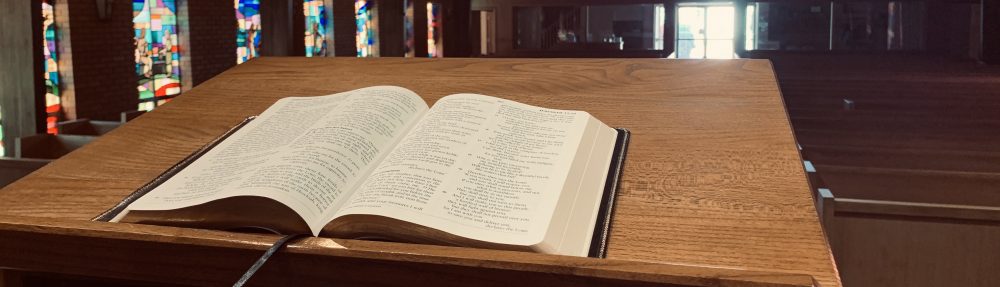
I’m preaching this Sunday on Growth in Righteousness as an essential aspect of the Christian Life. My text for Sunday is Matthew 5:17-20:
Do not think that I have come to abolish the law or the prophets; I have not come to abolish but to fulfill. For truly I say to you, until heaven and earth pass away, not one iota, not a dot, will pass away from the Law until all is accomplished. Therefore whoever sets aside one of the least of these commandments and teaches others to do the same, they will be called the least in the Kingdom of Heaven; but whoever does them and teaches them will be called great in the Kingdom of Heaven. For I tell you, unless your righteousness exceeds that of the Scribes and the Pharisees, you will not enter the Kingdom of Heaven. (This is my own translation).
I found this text, and the study of it through the week, to be very interesting considering what my denomination is considering right now. There is a motion being voted upon by the Presbyteries to remove the explicit ordination standard of “fidelity within the covenant of marriage between a man and a woman or chastity in singleness” from our ordination requirements, and to replace it with a rather innocuous, confusing, and ambiguous statment that uses a lot of words to say nothing at all.
I couldn’t read and meditate on Matt 5:19, “whoever sets aside one of the least of these commandments and teaches others to do the same,” without thinking of what’s happening in the church. The church continues to set aside or relax the Biblical teaching on marriage and divorce, sexual immorality and purity, tithing and stewardship – will Presbyterians be the least in the Kingdom? Will we be there at all?
We are called to righteousness. To reflect the glory of God is to live a righteous life. Jesus tells us that unless our righteousness exceeds that of the scribes and Pharisees, we will not enter the Kingdom of Heaven. We cannot be righteous apart from Christ, it is His righteousness that saves us, His righteousness that covers us. But at the same time, if the life we now live we live in the Spirit of Christ, then should not our lives reflect and be marked by righteousness as well.
We are quick to argue, “I am saved by grace through faith – not by works.” Yes, and amen. But read on, we are saved by grace through faith apart from works, “created in Christ Jesus for good works (righteousness). The purpose of God’s grace in your life, the goal of your salvation, is that you would give glory to God through the righteousness of Christ manifest in your life.
Martin Lloyd Jones put it this way:
The whole purpose of grace, in a sense, is just to enable us to keep the law. There is nothing more fatal that to regard holiness and sactification as expereicnes to be received. No; holness means being righteous, and being righteous means keeping the law. Therefore if your so-called grace (which you say you have recieved) does not make you keep the law, you have not recieved grace. You may have recieved a psychological experience, but you have never recieved the grace of God. What is grace? It is that marvllous gift of God which, having delivered a man from teh curse of the law, enables him to keep it and to be righteous as Christ was righteous, for He kept the law perfectly. Grace is that which brings me to love God; and if I love God, I long to keep His commandments. ‘He that has my commandments, and keeps them,’ Christ said, ‘he it is that loves me.'”
(Martin Lloyd Jones – Studies in the Sermon on the Mount – page 197).
Friends, stand firm, do not turn to the right or left from God’s word, but walk in the light that it shine upon your path, that you may grow in righteousness as you walk with the Lord.
SDG
 Reveds's Blog