The Only Real Comfort

“For you were bought with a price. So glorify God in your body.”
(1 Corinthians 6:20)

What is your only comfort, in life and in death?

There are a lot of things that bring me comfort – many of them involve bacon and/or gravy.  There’s the comfortable pair of jeans that I wear when I know I’m not going anywhere.  There’s the comfy chair which is guaranteed to produce a nap if I sit in it too long.  There’s a certain sense of comfort afforded by a 7 game post-season streak and a 3 game lead in the ALCS.  There’s even the comfort of depositing my paycheck in bank and knowing that I’m able to provide for my family.

Yet with all of these “creature comforts,” there’s always this sense that something’s missing, that I’m wanting something more.  As good as these things which bring me comfort may be, they do not truly satisfy the longing of my soul.

The human soul longs for meaning, for purpose, for satisfaction, for completion.  We are social creatures because, deeply wired in our existence, we are meant to be fulfilled by something other than ourselves.  We want to know we have made a difference, we want to leave a legacy.  We want to know that we have been right, not just correct, but righteous – on the side all that is good and lasting.  We want to know that we are secure, not just for today, but for eternity.

This is why the first question of the Heidelberg Catechism resonates with so many, it gets to the deepest longing – what is your only comfort, in life and in death?  Kevin DeYoung, in his book, The Good News We Almost Forgot, gives a little insight into the makeup of that question:

“Comfort” translates the German word trost, which was, in turn, rendered consolatio in the first official Latin version.  Trost is related to the English word “trust” and has the root meaning of “certainty” or “protection.”  Heidelberg is asking, “What is your solace in life?  What is your only real security?”

DeYoung, Kevin The Good News We Almost Forgot. (Moody Pub., Chicago, 2010) pg. 21.

The answer is this;

That I belong – body and soul, in life and in death – not to myself but to my faithful Savior, Jesus Christ, who at the cost of his own blood has fully paid for all my sins and has completely freed me from the dominion of the devil; that he protects me so well that without the will of my Father in heaven not a hair can fall from my head; indeed, that everything must fit his purpose for my salvation.  Therefore, by his Holy Spirit, he also assures me of eternal life, and makes me wholeheartedly willing and ready from now on to live for him.

Our only – the Catechism says, only – sole, unique, lone – comfort is that we belong to Christ.  More than bacon, more than the love of family, more than a healthy IRA – our belonging to Christ is the only thing which will bring us consolation, security, protection.

Christ has purchased us through the shedding of His blood.  Acts 20:28 tells us that Christ obtained the church with His own blood; 1 Cor 6:20 teaches that we have been bought with a price.  We were debtors to God’s glory, slaves to sin and death.  But through His cross, Jesus ransomed and redeemed us, our sins have been atoned for – all through His blood.  Our guilt, our shame, our debt has been covered.  We belong to Christ Jesus, and this is for our comfort.

What’s more, I am safe, kept in him.  Romans 8 tell us that nothing can separate us from the love of God in Jesus Christ, Jude 2 that we are kept in Him.  We are not just saved from wrath and sin, we are kept for righteousness – that we might be kept blameless before Him at His coming.  We are so preserved and protected by God’s grace in Jesus Christ that “not even a hair can fall from my head without His knowledge – and without it being for God’s purpose for my salvation.”  In Christ, there is nothing that I face that is not ultimately for God’s glory and my drawing nearer to Him.

Belonging to Christ Jesus, I am assured of eternal life and I am willing and ready to live for him.  Because He has saved and kept me unto salvation, I will live in His strength, His grace, His wisdom, joyfully serving and testifying to His goodness all my life.  I know that it is His strength that makes my work successful; His love that empowers mine.  I do not need to worry about tomorrow, or tomorrow’s tomorrow, for I know that, as Alpha and Omega, He holds all things in His hand.

What greater comfort is there than belonging to such a savior, of having your life hidden in His?  This comfort is meant to be our foundation, our starting place.  When you know that you belong, in life and in death, to Christ who purchased you, and that your life is secure in Him… well then I suppose you can face just about anything that comes your way!

SDG
I am Thenardier

“For all have sinned and fall short of the glory of God…”
(Rom 3:23)

This is my last installment on the Les Miserables theme, and my last shameless promotion for the Cherokee Community Theater’s Production.  Our opening week was met with tremendous success, and we hope to have a second weekend that’s even better.  The review have been great, the energy is high, and the tickets are going quickly.  If you haven’t already made your reservations, hurry – if you think there’ll be “One Day More”, you just might miss it.

Today, I wanted to take a moment to consider a couple in the show who just might be everyone’ favorite characters, the Thenardiers.  Not quite the antagonists of the story that Javert is, the Thenardiers are like a catalyst for the show, they come in at critical moments and create a volatility that propels the story onward.  They are despicable, opportunistic, criminal, and raunchy, but they also bring much needed comic relief to an already heavy show.

When we first meet Mssr. Thenardier in Hugo’s novel, he is profiteering off the dead and wounded at the Battle of Waterloo.  Moving quickly before the carrion birds arrive, or more troops come his way, he picks the pockets and mouths for gold and silver – and makes himself quite a fortune in doing so.

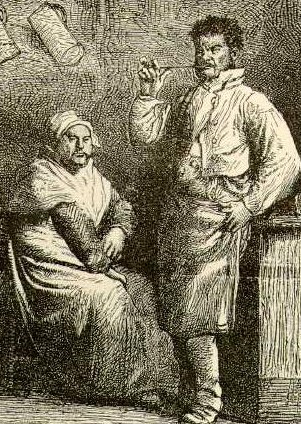
The Thenardiers operate an inn, which is merely another opportunity for him to “rook the guests and cook the books.”  Madame Thenardier is no better than her husband.  Hugo describes her as a monstrosity of a woman:

tall, blond, red, fat, angular, square, enormous, and agile; she belonged, as we have said, to the race of those colossal wild women, who contort themselves a
t fairs with paving-stones hanging from their hair… Everything trembled at the sound of her voice, window panes, furniture, and people. She had a beard. She swore splendidly; she boasted of being able to crack a nut with one blow of her fist. This Thenardier female was like the product of a wench engrafted on a fishwife. When one heard her speak, one said, “That is a gendarme”; when one saw her drink, one said, “That is a carter”; when one saw her handle Cosette, one said, “That is the hangman.” One of her teeth projected when her face was in repose.

In the story, they have five children: two girls, Azelma and Eponine, whom they spoil to no end, and three boys, Gavroch, who as soon as he is able is sent out to live on the streets, and two other boys, who are unnamed, and rented out to another woman whose children died.  The Thenardiers are also the custodians of Cosette, Fantine’s daughter, who essentially serves as slave labor for these horrid people.

Throughout the story, Thenardier’s world keeps crashing into the life of Valjean; attempted robbery, extortion, and murder. There are not admirable qualities in the Thenardier’s.  At the end of the book, we find Thenardier and his daughter Azelma heading to America, where they become slave-traders.  Truly a reprehensible character.

And yet, there is something revealing about the Thenardiers.  Lost people do lost things, and the Thenardiers are a vivid, graphic demonstration of that truth.  They believe God is dead.  They look to the heavens and only the moon looks down.  For them it is a dog eat dog world, you take anything that’s not nailed down.  Only the strongest, the fittest, the most cunning will survive.  Rarely do you see such an honest portrayal of the logical conclusion to a worldview that does not begin and end with a sovereign and loving God.  If you believe that we have emerged from a primordial ooze, there’s nothing to keep you from acting like it.

Rather than point my finger at the Thenardiers and cry out “sinner,” however, I think it is more important to let the Thenardiers point their finger at me and show me the state of my soul.  I am no better than they.  When left to my own devices, I am a greedy, grabby, self-indulgent, naval-gazing opportunist who thinks my way is the best way and just wishes that God would see the brilliance in my own plans and get in line.  I am a rebel from God’s way, living of the remains of the wasteland of my own making, rather than enjoying the abundant treasures that are at His right hand.  I am a wretch.

I want to be a Valjean, noble, sacrificing, the unsung hero.  I’d settle for Javert, the legalistic, militant conservative.  Heck, I’d take an ABC Student who dies on the barricade for the cause of freedom.  But no, I am Thenardier.  Who will deliver me from this body of death?

I guess I should correct myself.  That’s who I was.  But thanks be to God through Jesus Christ my Lord!  I have found grace.  I have been saved, redeemed, transformed.  I have died, and continue to die to sin, that I may live for Christ.  I have laid down the crown I stole for myself, and claimed Christ as my Lord and Savior.  I was the Thenardier, dead in my trespasses and sins, but I have been made alive together with Christ.  I was once captive to sin and death, but I have been delivered from the domain of darkness and transferred to the kingdom of his beloved Son.  This is the grace of God at work in my life.  This is the good news that I must share.

I love theater because it compels us to think.  It holds a mirror before us, and shows us the nature of our hearts.  And hopefully, in stories like this, it will show us our need for grace, for mercy, and for the saving love of God in Jesus Christ our Lord.

SDG

les mis add