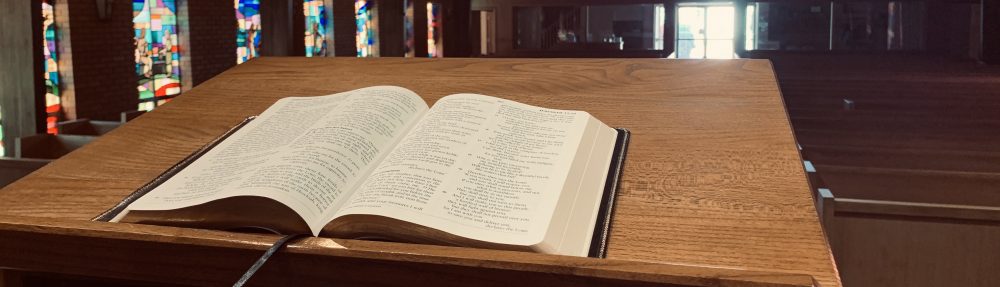
Beauty in Simplicity

“So faith comes by hearing, and hearing through the word of Christ”
(Romans 10:17)

I had a college theater professor who had a favorite phrase, one that I’m sure you’ve heard.  It really applies to every aspect of life, and if we used it more often, maybe things would go better.  Here it is:

K.I.S.S. – Keep It Simple, Stupid

Think about it.  If someone had applied this to the more than 10,000 pages of the Affordable Healthcare Act legislation, maybe things would have rolled out better (though I doubt it).  For that matter, just about anything that comes out of Washington seems to be a labyrinthine mess that only a room full of lawyers could ever understand, written so that people outside the beltway will never know what’s coming.  We really need to simplify things.

But not just in D.C.

I recently heard a message that was a complicated meandering through a hodge-podge of collected passages of Scripture, seemingly addressing a big issue in the world today, but never really saying anything about it.  Scripture says this, but it also says this, so we really can’t turn to Scripture to give us any answers here.  That wasn’t a quote, but it was the general theme.  When the message was finished, I had no idea what was ultimately said.

That’s not the way it should be.  Any pastor or teacher who equivocates on Scripture, who puts the Word of God and the teaching of the world on the same footing is, knowingly or not, leading the people astray and planting seeds of doubt in minds of the audience regarding the power of God’s Word.  A sermon should clarify the complicated in the light of Scripture, speak directly to those caught in sin God’s Word of judgment and hope in Christ, and present in a straightforward manner the life of faithful discipleship.

There are, of course, very complicated matters that the Bible addresses, and certain teachings of the church require great discipline and study and time to make them clear.  Still, the Westminster Confession teaches us:

All things in Scripture are not alike plain in themselves, nor alike clear unto all; yet those things which are necessary to be known, believed, and observed, for salvation, are so clearly propounded and opened in some place of Scripture or other, that not only the learned, but the unlearned, in a due use of the ordinary means, may attain unto a sufficient understanding of them.

To simplify: there are, indeed, complicated things in Scripture.  But everything that you need to know, believe, and do for your salvation is made perfectly clear in Scripture.

That’s why I love the passage above.  “Faith comes from by hearing, and hearing through the word of Christ.”  Beautiful.  Clear.  Direct.  Simple.

If you want to grow in faith, read the Bible.  God speaks, and we trust what He says – that’s faith.  God speaks to us when we read His word.  That is where we come face to face with God’s truth, with God’s promises, with God’s commands, with God’s love.  As we hear His word, as we trust and obey that word, our faith grows.

If you want to grow in faith, to overcome those nagging doubts, attend to God’s word.  Make His word a priority in your life, for in it you will find a vast treasure for your soul.

SDG

Repentance is…

“No, I tell you; but unless you repent, you will all likewise perish.”
(Luke 13:3 (ESV))

Imagine for a moment that you had a friend, a spouse, a child, who continually hurts you through what they said or done, and, when confronted about their behavior, readily apologizes and promises never to do it again, but only too soon returns to their offending behavior.  What would you do?  What would you think of their apology?  Would you still be able to trust and respect?  When someone we truly love and care for causes us pain, it’s one thing to know that they are sorry for what they’ve done, it’s something else entirely to know that they are trying to change their ways and never do it again.  We’re grateful for the apology, but what we really need is repentance.

Now at the risk of “meddling,” when given the opportunity for privately confessing your sins during worship on Sunday morning, or in that moment of honest reflection in your daily prayers, what do you confess before God?  Is it the same sin each day?  Do you find yourself coming back to God day after day, week after week, confessing the same sin?  While I encourage your constant struggle against sin and your return to the throne of God for mercy, I have to stop and ask, “How is that any different from the unrepentant apology of the friend, or spouse, or child mentioned above?  (Please know, I am writing to myself here more than anyone else.)

Charles Spurgeon once wrote, “the repentance which has no tear in its eye, and no mourning for sin in its heart, is a repentance which needs to be repented of.”  Repentance means to change your mind, to change your behavior, to turn yourself around.  To repent means that at one point you were headed in one direction, but now you’ve changed course and are going a new way.  If you say to God on Sunday morning, “I really am sorry for my behavior last night after the fifth round of drinks,” but next Saturday night you find yourself bellied up to the bar, that is not true repentance.  It may be regret, but it certainly is not repentance.

Here’s the thing: Genuine faith will produce heartfelt repentance.  If you truly believe that while you were still lost in sin, God, in His love, sent His Son Jesus Christ to die your death, to bear God’s wrath, and to offer you forgiveness and the promise of eternal life, then you will grow more and more aware how little you deserved this love and how nothing you could have done could have earned this love. Faith in such radical grace and undeserved love will naturally produce heartfelt sorrow and even a hatred for those things in our lives (covetousness, pride, anger, sexual sin) which offend the One who loves us so, and will teach us to flee from sin and to live joyfully according to the will of God in all good works (Heidelberg Q & A 88-89).  Listen to what the Westminster Confession says about repentance:

By [repentance] a sinner, out of the sight and sense, not only of the danger, but also of the filthiness and odiousness of his sins, as contrary to the holy nature and righteous law of God, and upon the apprehension of his mercy in Christ to such as are penitent, so grieves for, and hates his sins, as to turn from them all unto God, purposing and endeavoring to walk with him in all the ways of his commandments (WCF XV.2).

Unfortunately too many (progressives and conservatives alike) want Scripture to validate their choices and behavior, their opinion and prejudice, rather than submitting to Scripture’s authority as God’s word.  We stare deeply into the well only to find our own reflection looking back and, liking what we see, think that the Bible takes our side and supports our position.  We tell ourselves, “Now that I’ve confessed my sins, and God says he loves and accepts me just the way I am, why should I ever have to change?” 

Let us once again hear the Confession’s call to repent:

They who, upon pretence of Christian liberty, do practice any sin, or cherish any lust, do thereby destroy the end of Christian liberty; which is, that, being delivered out of the hands  of our enemies, we might serve the Lord without fear, in holiness and righteousness before him, all the days of our life (WCF XX.3).

Repentance is an ongoing practice, where by the power of the Holy Spirit through the word of God we are continually being convicted of our sin, learning to turn from it unto righteousness, and seeking forgiveness and reconciliation with God and neighbor.  Repentance is part of the Sanctifying work of God’s Holy Spirit within us, destroying the body of sin, mortifying the savage lusts that once ruled our hearts, and working growth in grace and holiness before God.

I leave you with one last thought from Spurgeon:

The man who has led the purest life,
when he is brought before God
by the humbling influence of the Holy Spirit,
is the man who almost invariably
considers himself to have been viler than anybody else.

Repentance is to leave
The sin we loved before,
And show that we in earnest grieve
By doing so no more.

Grace and peace,

SDG