Hopes for General Assembly

Two weeks from now I will be in the steamy south of Mobile, AL attending my first ever General Assembly of the PCA. I’ve never been to Alabaman before, so I’m looking forward to the visit, and a little nervous about exploring new places.  In addition to the fact that I will be away from the family for a week,  rebounding from this trip to a week at Church Camp, I have some trepidation about going to GA.  Let me try to explain.

My experience with General Assembly meetings in the PCUSA have not gone well in the past.  I first attended General Assembly back in 1994 when it was in Wichita, KS.  I was working that summer at a church camp in S.E. Kansas, and because GA was in Wichita, the High School camp ended early, and we bussed the kids to GA for the opening worship service and an overnight lock-in with other PCUSA students from around the nation.  The lock-in was frustrating: there was no Biblical teaching, just a long night of dodge-ball, movies, and food. Everything a kid would want, but nothing that they needed. I saw it as a wasted opportunity to equip the students, who one elder said were “the future of the church” to grow in their understanding and love of God in Jesus Christ and to become engaged in the evangelism and outreach of the church.

Fast forward almost 18 years. I was serving as a PCUSA pastor in NE Iowa, and the denomination was again contemplating changing its ordination standards to allow for the ordination of practicing, unrepentant, homosexuals as Teaching and Ruling Elders and Deacons.  My session had approved a motion requesting a moratorium on the ordination issue, calling for a time of prayer and discernment.  The motion was approved by the presbytery, and I was asked to present the motion to the General Assembly.
stoles

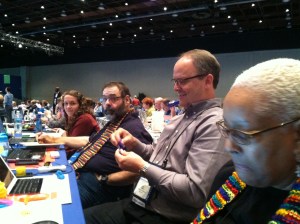
Hmm, how do you think I’m going to vote?

This was my Daniel in the Lion’s Den moment.  I walked into the conference center, and was immediately greeted by other commissioners bedecked with Rainbow Stoles, making clear where they stood on the matter of ordination.  Any hope for an open-minded reception was gone.  The opening worship service for the Assembly included 12 foot puppets, dancing through the congregation during the “blessing of the four directions.” The motion I presented was laughed at in the committee hearing (by the open-minded-stole-wearing-delegates), and the motion to change the standards of ordination were passed by the GA and eventually by a majority of presbyteries.


So I head to the PCA General Assembly wary of the political nature of such gatherings, but also optimistically hopeful about what may come.  Next week, I will share some of the business that we will be discussing at General Assembly, but today, I simply offer my prayers for what I will experience.

My prayers for General Assembly:

  1. Fewer Shenanigans.  I don’t want to see puppets, milk and honey ceremonies, Rainbow Stoles or Naked Cowboys in worship. That should go without saying.  Still, there are temptations for large scale gatherings to push boundaries and make waves, for no other reason than to push boundaries and make waves.  I guess what I’m hoping for here is just that we can be a gathering of the Church, where we come together to hear God’s word, to pray with and for one another, and to work for the peace and purity of the body of Christ.
  2. Biblical Teaching and Worship.  We have some fantastic Biblical scholars in the PCA, and at one time, the name Presbyterian was synonymous with solid, reformed Biblical teaching. I would hope that we could use our national gathering to lift up Biblical teaching and the application of Scripture to our current context in an increasingly “post-Christian” America.
    How we proclaim the Good News, and how we Worship according to the authority of God’s Word, can have a transforming effect on our world today.  I pray that this is happening in my own congregation, and would love to see it at our General Assembly as well.
  3. Prayerful and Biblical Discussion on Important Matters.  There are a lot of important and very difficult issues that the church faces today, and we need to have profound and meaningful conversations and debates on these matters.  Yet I pray that we can learn how to have these conversations, how to disagree with one another, and still love one another and strive to maintain the bond of peace and unity in Christ.
  4. Genuine Fellowship as the Body of Christ. Ultimately, I guess what I’m hoping for as I prepare for General Assembly is that I will be going to Church, called by Christ to be with my Fathers and Brothers who have also been called by Christ, to be a Church that lives for the glory of God.

Be praying for me, for the Presbyterian Church in America, as we come together for our General Assembly (June 20-24, 2016).  I’ll be trying to post updates while at GA, so keep checking in here at the blog.

SDG


How the Holy Spirit Works… (Part 2)

Beloved, do not believe every spirit, but test the spirits to see whether they are from God…”
(1 John 4:1 ESV)

A couple of months ago I posed the question, “How does the Holy Spirit work?”  The question was particularly relevant (and remains relevant) as I was about to embark on my first experience at the General Assembly of the PC (USA).  Entrenched advocates for both progressive and traditional views on every issue claimed to have the power and influence of the Holy Spirit.  Nearly every forthcoming decision was said to be the “will of the Spirit,” even those that were passed by very narrow margins. 

I just recently finished the book, A Quest for Godliness: the Puritan Vision of the Christian Life (J.I. Packer), which I had been reading for a pastor’s study group.  Within the discussion on the nature of revival and evangelism within the church, Packer turns to Jonathan Edwards.  The prevailing question of Edwards’ day was the same as ours, “how do we know when the Holy Spirit is moving?”  Edwards preaching brought great revival, but many in his day dismissed the claims that the revival was authentic because of the emotionalism and experimentalism (i.e. experiential) nature of the revival.  To answer his opponents, and following the teaching of 1 John 4:1-6, Edwards distinguished the marks of the work of the Spirit of God as follows:

  1. When the operation is such as to raise their esteem of that Jesus who was born of a Virgin, and was crucified without the gates of Jerusalem; and seems more to confirm and establish their minds in the truth of what the gospel declares to us of his being the Son of God, and the Savior of men; it is a sure sign that it is from the Spirit of God… The devil has the most bitter and implacable enmity against that person, especially in his character of the Savior of men; he would never go about to beget in men more honorable thoughts of him.
  2. When the Spirit that is at work operates against the interests of Satan’s kingdom, which lies in encouraging and establishing sin, and cherishing men’s worldly lusts; this is a sure sign that it is a true, and not a false, spirit… It is not to be supposed that Satan would convince men of sin, and awaken the conscience.
  3. The spirit that operates in such manner, as to cause men a greater regard to the Holy Scriptures, and establishes them more in their truth and divinity, is certainly the Spirit of God… A spirit of delusion will not incline persons to seek direction at the mouth of God.
  4. The spirit operates as a spirit of truth, leading persons to truth, convincing them of those things that are true… that there is a God, and that he is a great and sin-hating God; that life is short, and very uncertain; and that there is another world; that they have immortal souls, and must give account of themselves to God; that they are exceeding sinful by nature and practice; that they are helpless in themselves…
  5. If the spirit that is at work among a people operates as a spirit of love to God and man, it is a sure sign that it is a Spirit of God.

These criteria could be, and ought to be applied to any movement within the church.  Does this program, message, mission, statement, etc., raise our esteem of Jesus and bring others to faith in him?  Does it mortify sin and lust and promote righteousness and truth?  Does it stand in accord with a straightforward and clear understanding of God’s word, and call us to a greater reliance upon Scripture?  Does it lead us to greater truth about God and ourselves, and our ultimate and absolute dependence upon God?  Does it promote love, love to God and to man, a love that is pure and holy?

I Kings and 2 Chronicles both retell the story of the prophet Micaiah.  Micaiah was summoned to King Ahab to tell the king whether he would be successful in battle.  When pressed, Micaiah told Ahab that he would fall in battle, and that the people would be scattered like sheep without a shepherd.  The rest of Ahab’s prophets had given a favorable vision, so Ahab asked why Micaiah was such a trouble maker.  This is his reply:

“I saw the Lord sitting on his throne, and all the host of heaven standing beside him on his right hand and on his left; and the Lord said, ‘Who will entice Ahab, that he may go up and fall at Ramoth-gilead?’ And one said one thing, and another said another.  Then a spirit came forward and stood before the Lord, saying, ‘I will entice him.’   And the Lord said to him, ‘By what means?’ And he said, ‘I will go out, and will be a lying spirit in the mouth of all his prophets.’ And he said, ‘You are to entice him, and you shall succeed; go out and do so.’   Now therefore behold, the Lord has put a lying spirit in the mouth of all these your prophets; the Lord has declared disaster for you” (I Kings 22:19-23 ESV).

Judging by the direction our denomination seems intent to take, I am left to wonder if God has not sent out a lying spirit into our midst to entice us.  When a church puts truth on the level with a lie and promotes moral turpitude and humble piety as equally valid options for life, which spirit are we following?

What the church needs now, as much as ever, is an outpouring of the Spirit of God.  We don’t need a spirit of inclusivity.  We don’t need a spirit of peace.  We don’t need a spirit of unity.  While the Holy Spirit surely includes those who have been outcasts; while the Holy Spirit brings peace where there has been enmity; while the Holy Spirit brings unity where there has been division; what we need more than anything else is true communion with God through Jesus Christ our savior in the power of His Holy Spirit.  No judicial action, no legislative position, no assembly’s decision can replace our need for the authentic and powerful presence of God’s Spirit in our church.

May God’s Spirit move upon our church today!

SDG