“And this will be a sign for you…”
(Luke 2:12 (ESV))
There is a difficult truth that we are reminded of every time a child is presented for baptism: We are born sinful and in absolute need of a savior to deliver us from our sins. It is hard to look at a beautiful new born child and see a sinner (a little easier at three months when you aren’t sleeping at nights and have been pooped, peed, and puked on), but the teaching of Scripture stands.
The Bible says that we are born sinners and that we are sinful by nature:
- Psalm 51:5 says, “Behold, I was brought forth in iniquity, and in sin my mother conceived me.”
- Ephesians 2:2-3 says that all people who are not in Christ are “sons of disobedience,” and “by nature children of wrath.”
- Genesis 8:21 declares, “…the intent of man’s heart is evil from his youth.”
We don’t like to dwell on this truth of scripture, but if we deny it we deny the reality of our condition apart from Christ. We are, from birth, sinful in nature, born into a fallen state, children of wrath. We are, from birth, sinners in need of a savior.
And so it is all the more powerful when we consider that our Savior Jesus Christ, whose birth we celebrate every Christmas, was born to die.
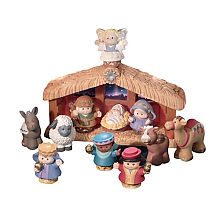
When I was at Sterling College, I had the privilege of studying under Dr. Abraham Terian, a Biblical Scholar and Archeologist who was born and raised in Jerusalem. He shared insights on the story of the Nativity from the Gospel of Luke that were revolutionary for me. My mind had been so shaped by the renaissance period nativity sets that I had seen growing up, that I never considered what the nativity would have looked like in 1st century Palestine.
Dr. Terian taught us that the stable would not have been a barn like we use today, but most likely a cave or grotto with a gate placed in the opening to keep the animals in. These caves were common in that region, and had a variety of uses – including burial.
The manger in which the Christ-child was laid to rest would not have been made of wood like the ones you see portrayed today, but rather of stone. Wood was scarce, and easily broken, while the large stone troughs would have been more durable, holding water and straw to feed the sheltered animals.
Even the “swaddling cloths” were a sign of the Baby’s destiny. In the time which Jesus was born, traveling was dangerous. Travelers knew that they could get sick, or be attacked, and it was possible they might die on their journey. To prepare for this possibility, travelers would take a long, thin cloth and wrap it around their waist many times. This cloth would be reserved for death. If someone died during the journey, their friends or family would remove the “swaddling cloth” and wrap them from head to toe so they could compete the journey (which sheds some light on the story of the Good Samaritan – “and he fell among robbers who stripped him and beat him and departed, leaving him half dead”). The “swaddling cloths” which Jesus was wrapped might have likely been the burial cloths that Joseph would have carried for himself.
In the Gospel of Luke, the sign given to the shepherds was that they would “find a baby wrapped in swaddling cloths and lying in a manger,” that is, they would find a child, wrapped in burial cloths, laid on a stone, buried in a cave. Everything about this picture reminds us that the Christ Child, Immanuel, has come to die.
This isn’t the Christmas Story that we like to focus on. Think about it, how many times do we actually sing the second verse of “What Child is This?”
Why lies he in such mean estate, where ox and ass are feeding?
God Christians, fear; for sinners here the silent Word is pleading.
Nail, spear shall pierce him through, the cross be born for me, for you;
hail, hail the Word made flesh, the babe, the son of Mary.
We’d rather hear about the angels singing “Glory to God,” about the love that came down at Christmas, about peace and goodwill toward men. And well we should. But the angel’s song, the love, joy, peace, and goodwill, would be meaningless unless there was also a promise of deliverance and salvation from sin.
Just as we are born in sin, Jesus was born to save us from our sin. The One born with the gift of life came for those who were born in death. This child in the manger is the Lamb of God who takes away the sins of the world.
Celebrate Christmas. Rejoice and be glad for your King has come. But never forget that the One who came so meek and mild is the One who took the cross for our salvation.