
Have you found Jesus?

“Where is he who has been born king of the Jews?”
(Matthew 2:2 (ESV))

So, the Sayler house is decorated for Christmas.  The tree is up, with all of its trimmings (including brand new working lights – that’s another story).  The garland hangs from the fireplace mantel; the stockings are there too, awaiting a visit from jolly old Saint Nick.  I even managed to get the lights up outside before the wind and cold set in, which is saying something for living in NW Iowa.

Of all the decorations that we have out for Christmas, I think the little boys’ favorite must be the “Little People Nativity Set.”  It’s a little play set nativity, complete with Wise Men, Shepherd, various livestock, and of course, Mary and Baby Jesus (curiously, no Joseph – must have gone to the store for diapers).  The boys love to play with the figures of the nativity, right alongside their toy Superman, Batman, and other Super Heroes.  More than once I’ve seen the Son of Man, nestled in the manger, flying side by side with the Man of Steel – I’m so proud.
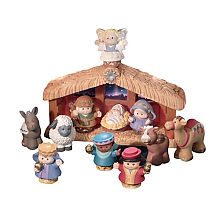
The one downside is, there are so many pieces, they tend to go missing throughout the day.  At lunch, supper, and bed time, we have a family search for the missing characters.  Recently, the most notoriously lost seems to be baby Jesus.  My house is beginning to sound like a Baptist revival.  “Have you found Jesus?”  “I found him, I found Jesus!”

Sometimes Jesus is hidden under the couch or radiator.  Other times he’s under the piles of Christmas Story books that get put out on the coffee table this time of year.  Then sometimes Jesus get hidden in toy baskets, under coats, and amongst the other clutter of the house.

As we were once again searching for the Christ child last night, I began to realize this was a great lesson for us as adults.  Is Jesus missing from your Christmas?  Have you found Him?  Are you even looking?  Did you even notice he was missing? 

Sometimes Jesus gets buried under the furious rush to find all the right presents, getting the Christmas cards written and mailed, and having the decorations just right.  Sometimes Jesus gets lost in all the busyness and chaos of a season that is supposed to be a celebration of the coming of the Prince of Peace.  All too often, without even thinking about it, we just push Jesus off to the side of our celebration, “I’ve got too much going on to worry about all that religious stuff too!”

At the risk of sounding cliché, it is so important that we keep Christ in Christmas.  If we can’t keep Jesus at the center of our Christmas celebration, is it really Christ’s mass?  If we can’t spend the Advent season developing a longing and expectation for the return of our King, will we ever?  If we lose Jesus at Christmas, how will we ever hope to find him throughout the rest of the year?

My encouragement to you this Christmas, and anytime throughout the year, is keep searching for Jesus.  Watch for Him, wait for Him.  See where He is missing in your life, and search for Him as if your life depended on it.  Turn to the Scriptures to hear His word again; His word of life, of hope, of righteousness and peace.  Repent and confess of those things which you have put before Christ, which have kept you from the joy of obedience to your Lord.  Make worship, privately and corporately, a priority, so that you may find yourself where Christ has promised to meet us.

My prayer is that in all of your celebrations this season, you will find Jesus again and again.  That would really be a Merry Christmas.

SDG

Get Real

“If we say we have no sin, we deceive ourselves and the truth is not in us.  If we confess our sins, he is faithful and just to forgive our sins and cleanse us from all unrighteousness.” 
(I John 1:8-9 ESV)

Today being Ash Wednesday, the beginning of the Lenten Season, there is a lot of attention placed on penitence and confession.  Fat Tuesday was spent in wild celebration so that there would be something to confess on Ash Wednesday (as if there wasn’t enough already). 

But what does it really mean to confess your sins?  What does a genuine confession look like?  Now that there’s an App for Confessions (see here), what is the proper form of confession?

If you do a quick study on the word “confess” in Scripture, you will find it has less to do with producing a laundry list of the things for which we feel sorry, and more to do with a humble and heartfelt acknowledgement of the truth.  In the Hebrew, the primary word used for confess is “yadah,” which literally means to throw or shoot, but is also translated as to give thanks and praise to God, to confess that the Lord is God (2 Chron 6:24), and to confess the truth of our sinfulness before God (Lev 5:5).  Interestingly, this word is closely related to the word “yada” which means “to know.” 

In the Greek, the word for confess is “homologeo” which literally means “to speak as one.”  Again, in the Greek this refers not only to our confession or acknowledgement of our sins (James 5:16), but also our confession of Jesus as Lord (Rom 10:9; Phil 2:11), and even His confession of our name before the Father (Rev. 3:5).

So to make a confession is to acknowledge what we know to be true (we do this every week in worship when we make a “Confession of Faith”).  The word confess means that you stand with God and you say what God is saying.  It means to acknowledge the truth of Scripture.  It means to acknowledge the truth of Jesus Christ.  It means to acknowledge the truth about ourselves and our sins. To confess is to say about your sin exactly what God says about it. You call your sin what God calls it. That is what it means to confess.

I heard one pastor put it this way: “To confess your sin is not simply that you come with this general acknowledgment that you have messed up, that you have not been everything you should be as a husband or a wife, that you have not attained to all that you would like to have attained in your life. Confession of sin is not some vague, acknowledgment of being a general flop. But it is a confession of your sin: that you have deliberately missed the mark of God’s call and God’s law.”

Kevin DeYoung writes in the book “Why we love the Church”

It’s all to easy for me to say, “I’m sorry for not doing more to help the poor, and I’m sorry I haven’t been more loving, and I’m sorry I haven’t done more for the homeless.”  But is this real repentance if I don’t go out and do something differently after my confession… Before we loudly protest all our general failings, we would do well to remember that repentance entails a change of direction and not merely a public declaration that “I could have done more.”  We shouldn’t say we’re sorry because it sounds good or makes us look good before others, but because we actually feel regret for some wrongdoing and are intent on living more like Christ in the future. (DeYoung, Kevin.  Why we love the Church (Moody Publishers, Chicago; 2009) page 137).

As long as your confession of sin is kept at arm’s length, an utterance of the generalities that, yes, we are all sinners, nobody’s perfect, but never really acknowledging the truth about ourselves, we are deceiving ourselves and the truth is not in us.  We are not saying the same thing God is saying, we are, in fact, calling God, and His word, a liar.

But if you confess…  If you acknowledge the revelation of Scripture, that God is Holy and Righteous in His judgment against sin; that we are all sinners who have fallen short of the glory of God and stand condemned under His righteous judgment; that Jesus is the Christ, the only begotten Son of God, the sinless one upon whom all our sins were laid, died to redeem us and to set us free from sin and death, and has taken God’s judgment and wrath upon Himself that we might be free to live for God… If you confess, if you acknowledge the truth, then you stand with God and the truth dwells in you (I John 4:15).

Friends, let today be a day of confession.  A day of acknowledging the truth about God and the truth about ourselves.  Get real with God.  Confess your sins, yes, and confess your faith as well. 

SDG